


With months remaining in office, California Gov. Gavin Newsom has decided to force a confrontation over one of the largest unresolved risks hanging over the state’s utilities, insurers and infrastructure investors: who absorbs the next catastrophic wildfire loss.
- Newsom is pushing an eleventh-hour overhaul that would limit some utility liabilities, restrict insurers’ ability to recover claims payments and create a faster compensation program for wildfire survivors.
- Utilities say that without a more predictable framework, credit downgrades and higher financing costs could threaten billions of dollars of investment needed for wildfire mitigation, grid expansion and the AI data-center buildout.
The market is already drawing a sharp distinction between companies that carry California’s wildfire liabilities and those positioned to benefit from the investment response.
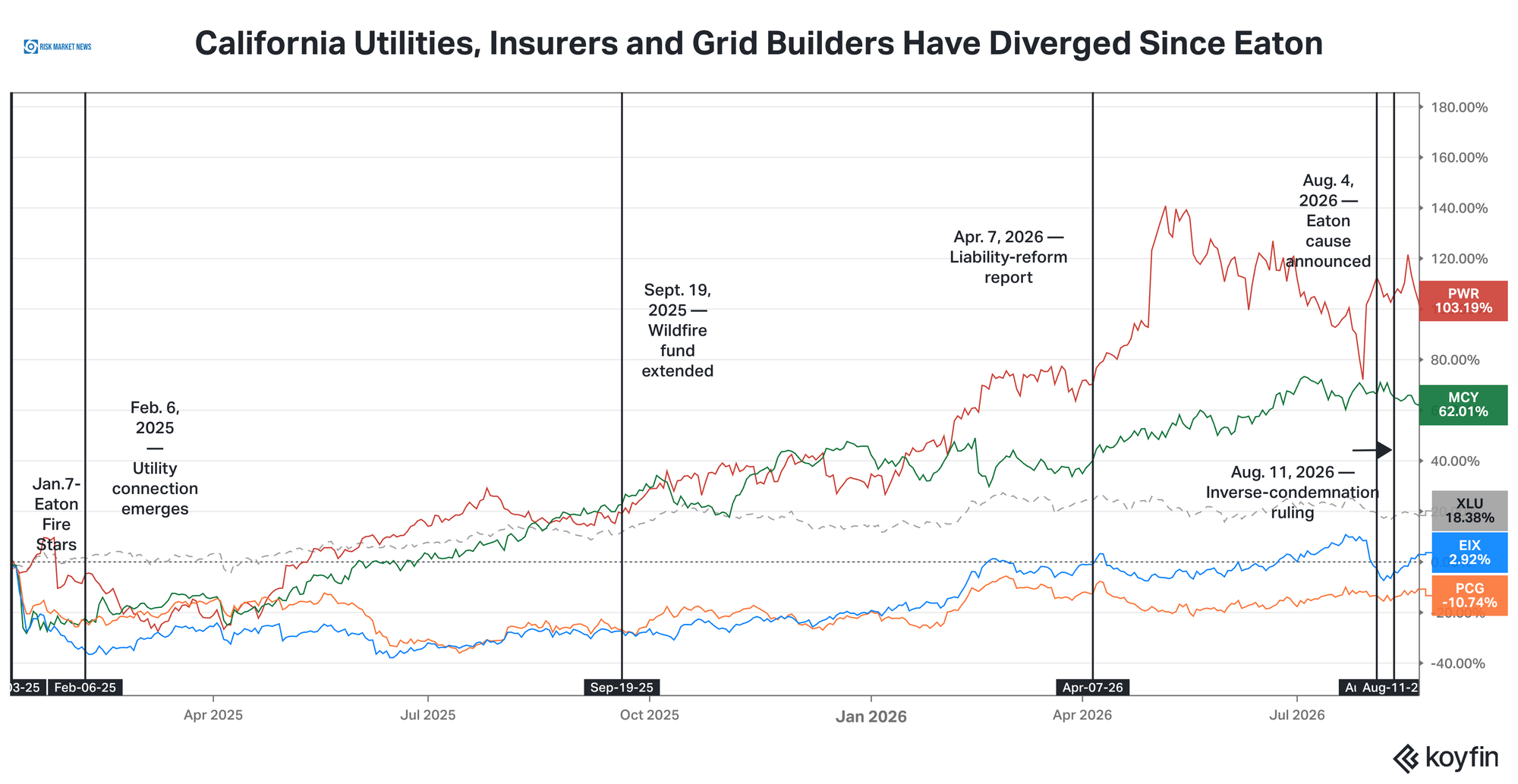
Since January 6, 2025, Quanta Services has more than doubled and California insurer Mercury General has gained 62%, compared with an 18% return for the broader utility sector.
Edison International is roughly flat, while PG&E has fallen nearly 11%.
- The divergence does not prove that wildfire policy alone drove these stocks, but it shows investors treating catastrophic liability and grid investment as very different financial propositions.
That is the backdrop to California’s liability-reform battle.
Edison and PG&E represent utilities seeking greater certainty around potentially unlimited wildfire claims; Mercury represents an insurance market attempting to reprice California catastrophe risk; and Quanta is a proxy for the grid hardening and expansion required by the AI data-center boom.
The outcome will help determine whether the next catastrophic loss remains with utility shareholders, moves through insurers and the FAIR Plan, or is ultimately absorbed by ratepayers and taxpayers—and whether utilities can attract the capital required to build what comes next.
Newsom is attempting to cap the financial tail
Under the proposal reported by Politico, insurers could be prevented from suing utilities to recover claims they have already paid; a process known as subrogation. Financial firms could also be barred from purchasing those claims and pursuing utilities themselves.
The proposal would create a state-administered fast-pay program for survivors while limiting certain emotional-distress claims. Local governments could face restrictions on recovering the full replacement cost of destroyed infrastructure.
Newsom argues that the existing system cannot survive another loss on the scale of the Camp or Eaton fires without risking another utility bankruptcy.
“The status quo is not going to work.”
California’s current inverse-condemnation framework can impose liability on investor-owned utilities when their equipment causes a wildfire even if negligence has not been established. The state created a shareholder- and ratepayer-funded Wildfire Fund in 2019 to prevent that liability from pushing another utility into bankruptcy, then added $18 billion to the fund last year through SB 254.
The Eaton Fire has already begun testing that structure.
Southern California Edison told investors in July that it had extended more than 2,200 settlement offers totaling over $775 million to approximately 12,300 people through its voluntary compensation program. More than 30,000 claims have entered litigation, and Edison has settled with two insurers at approximately 55 cents on the dollar.
The company said those payments have crossed the $1 billion threshold required to begin drawing from the Wildfire Fund.
Utilities are tying liability reform to the AI buildout
The most consequential threat from utilities is not necessarily another immediate bankruptcy. It is a slower withdrawal or repricing of the capital California needs to harden and expand its grid.
Edison CEO Pedro Pizarro told investors that the legislative outcome would influence the cost of capital available for future investment. An insufficiently predictable framework, he warned, could raise financing costs and change how Edison prioritizes capital after its currently approved plan expires.
PG&E was more explicit.
Its five-year, $73 billion capital plan assumes California will strengthen its wildfire liability framework. Management warned that an inadequate outcome would force it to reconsider its long-term investment priorities.
“There will be action in the event of inaction on the part of the legislature,” PG&E CEO Patti Poppe told analysts.
Approximately $16 billion of PG&E’s plan is associated with system hardening and resilience, while another $23 billion is tied to capacity and new customer connections.
PG&E’s potential data-center pipeline now exceeds 12 gigawatts. The company estimates that every gigawatt of additional data-center demand, if priced appropriately, could reduce existing customers’ bills by at least 1%. But connecting that demand requires substations, transmission capacity and other long-lived infrastructure financed with debt and equity capital. PG&E says a constructive liability framework would accelerate its return to an investment-grade credit rating and reduce financing costs.
Investors also have alternatives.
Sempra is increasingly directing capital toward Texas, where Oncor has a $47.5 billion base investment plan and another $10 billion of identified opportunities. Sempra told analysts that California rate base is growing approximately 5%, significantly more slowly than its broader utility platform.
Every solution sends the loss somewhere else
Insurers and local governments reject the idea that limiting utility liability eliminates wildfire costs. It merely changes who receives the bill.
The insurance industry says eliminating subrogation would force insurers to incorporate unrecoverable utility-caused losses into premiums or reduce exposure to wildfire-prone areas.
“We don’t think it’s fair to make insurance policyholders pay more to bail out utility shareholders,” APCIA’s Denni Ritter told CalMatters.
A coalition of California cities and counties argues that limiting infrastructure claims to depreciated value would leave local taxpayers responsible for rebuilding roads, water systems, schools and fire stations. Public-agency damages represented only 4% of total utility wildfire claims paid between 2017 and 2024, according to the coalition.
Schools warn that restricting subrogation could raise their insurance costs. Meanwhile, a coalition including the Natural Resources Defense Council, American Clean Power and the Solar Energy Industries Association argues that another utility insolvency could jeopardize power-purchase agreements, grid modernization and California’s clean-energy targets.
RMN: Newsom’s final challenge is not making wildfire losses disappear. It is deciding which balance sheet will hold them when the next catastrophic fire arrives.
The financial tradeoff is becoming harder to separate from California’s economic ambitions. The state wants utilities to finance wildfire mitigation, clean-energy infrastructure and the grid needed to support AI, while leaving them exposed to potentially unlimited catastrophe losses.
Liability reform is the final boss the California must resolve that contradiction before investors decide the capital is better deployed somewhere else.
