


Large real estate investment funds are paying less to insure properties against disasters, even after accounting for the individual buildings’ exposure to hurricanes, floods, earthquakes and wildfires, according to new research from the Massachusetts Institute of Technology (MIT).
The research says that catastrophe risk in the $22.5 trillion U.S. commercial real estate market is not priced building by building, but instead insurers are taking into accounting diversification and scale of the investment portfolio surrounding each property when pricing risk.
“Insurance negotiations in CRE are conducted at the portfolio level, and certain portfolios can receive significant discounts,” a senior manager at a major commercial real estate insurer told the researchers.
The September working paper from the MIT Center for Real Estate, , combines insurance expenses reported to NCREIF with property-level catastrophe risk modeled by Moody’s RMS.
As an example, the researchers use the effect with two similar Portland-area properties worth approximately $14 million and $13 million that RMS estimates their annualized disaster-damage rates at nearly identical levels.
Yet one incurred quarterly insurance expenses of $70 per 1,000 square feet compared with $51 for the other — a 37.5% difference.
“The distinction is not the properties themselves; it is the fund portfolio they sit in,” the study says. The portfolio containing the more expensive property had roughly 14 times the average disaster-risk exposure of the other portfolio.
Across more than 215,000 property-quarter observations, the researchers found that a 10% increase in a portfolio's average disaster risk increased an individual property's insurance expense by about 0.4%, even after controlling for the property's own modeled risk.
The size of the portfolio also worked in the opposite direction.
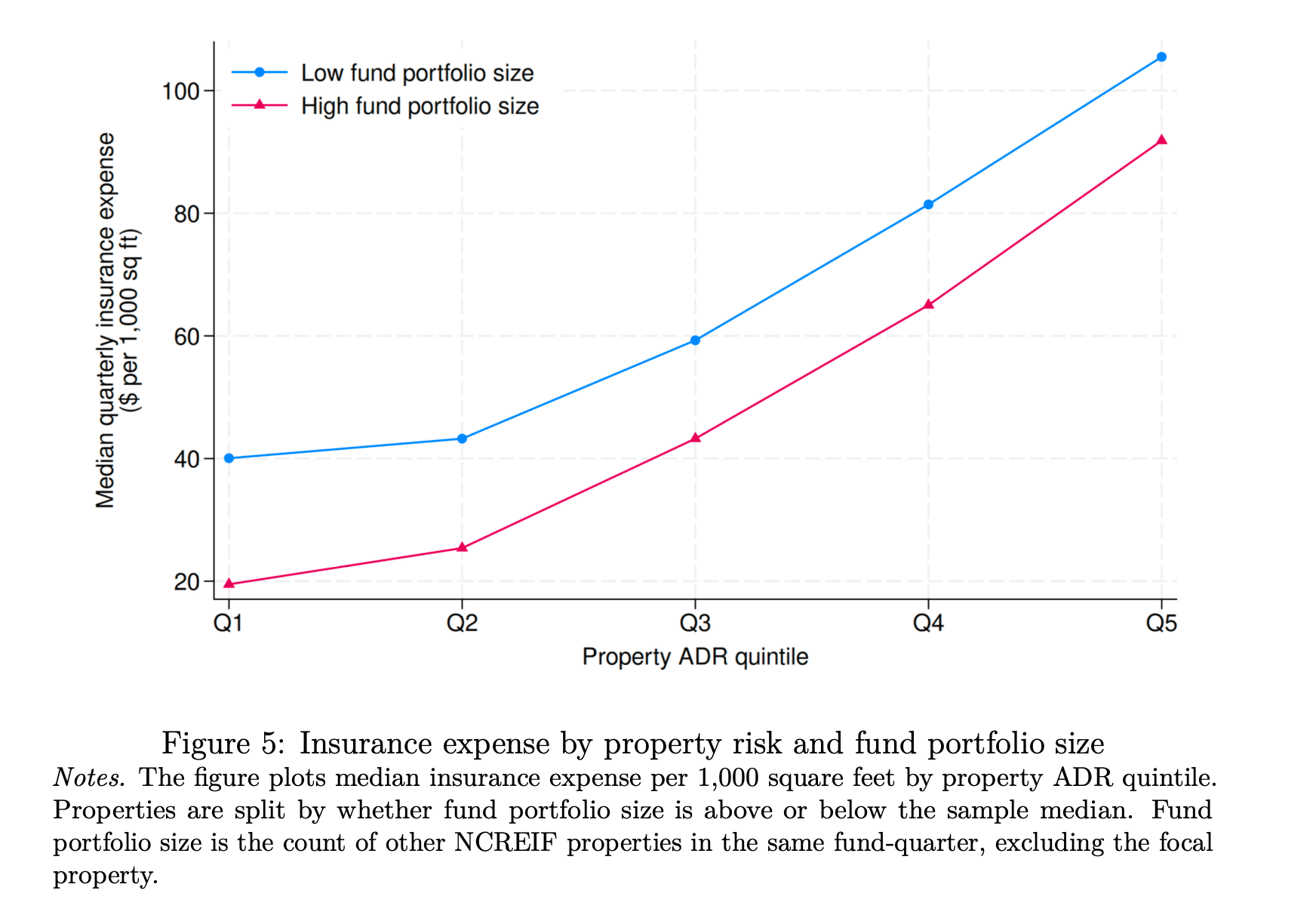
Moving from the median fund size to the 90th percentile was associated with a 7.6% reduction in insurance expense, or about $2,268 annually for a property with the median insurance bill.
The researchers attribute that advantage partly to spreading underwriting, modeling, brokerage and administrative costs across more properties. Large portfolios can also have greater bargaining power and alternatives including captives, retained risk and direct access to reinsurance.
But diversification appears less valuable when insurance capital becomes scarce.
After the commercial insurance market began hardening in late 2017, the researchers found that the pricing benefit associated with greater portfolio diversification was almost completely eliminated, while the discount associated with fund size persisted.
“The premium discount earned by holding a heterogeneous pool is therefore the component of pricing most sensitive to the cycle,” they write, “compressing toward zero when capacity is constrained.”
The consequences extend into property valuation.
Insurance expenses reduce net operating income (NOI), meaning otherwise identical buildings can produce different NOI — and potentially different underwriting values — depending on which portfolio owns them, the study says.
