


You're reading the last Wednesday Midweek Edition.
Starting Monday, June 1, RMN goes daily — a free Morning Brief
(Monday–Friday, 6:30 AM ET). Longer, analytical editions with exclusive data and risk market insights will be part of the RMN Member Briefing: paid members only, Thursdays at 1:00 PM ET, starting June 4.
If you're already a paying member, you're automatically on both. No
action needed.
If you're a free reader and you want the analytical edition every
Thursday.
On the surface, next week's California insurance commissioner primary is about traditional insurance industry issues: claims delays, FAIR Plan dysfunction, and who was underinsured when the Palisades and Eaton fires tore through Los Angeles County in January 2025.
While those entail real technical disagreements between the candidates, there is a larger structural question that none of them has squarely addressed, one that broader risk markets are already working into their California capital assumptions: the state's accelerating AI and data center buildout is adding load to a grid whose ignition risk is already poorly priced.
Whoever wins this race will inherit that problem.
The Race at a Glance
The field spans a meaningful ideological range.
State Sen. Ben Allen carries establishment Democratic endorsements and has introduced legislation that would give the commissioner broader authority to hold insurers accountable. Former Southern California Edison executive Steven Bradford is proposing a public-private risk-sharing partnership to keep carriers in the state. Republican Merritt Farren — whose Palisades home was destroyed in the fires — has put forward a "CAL Reinsure" proposal that would create a state-backed entity funded by insurer fees, empowered to issue bonds into the commercial market, effectively standing in as a public reinsurance backstop that would render the FAIR Plan redundant.
Financial analyst Patrick Wolff, largely self-funded, is focused on transparency and a public insurer report card.
The sharpest break belongs to Jane Kim, head of the California Working Families Party and endorsed by Bernie Sanders. Kim is running on a single-payer public disaster insurance layer modeled on New Zealand's Toka Tū Ake EQC structure, under which the state would absorb fire and flood risk as a first layer, leaving private carriers to cover other perils. Critics call it unworkable. What it actually is, from a capital markets standpoint, is a preview of where the political pressure is heading if premium increases continue and private market retreat accelerates.
Allen has the fundraising advantage and a $1 million independent expenditure injection from a cryptocurrency executive. The top two finishers advance to November.
The Cat Model Problem Nobody Is Talking About
The candidates are debating whether to allow catastrophe model use in rate-setting — a reform that Ricardo Lara's Sustainable Insurance Strategy already opened the door to — but none appear to be asking whether the models themselves are adequate for a grid under AI-era electrical load.
Both PG&E and Southern California Edison disclosed the scale of what is coming in their Q1 2026 earnings calls.
PG&E CEO Patti Poppe noted that customer interest in new large load connections across its service area had reached more than 10 gigawatts in its latest cluster study, with "no single project driving these totals" and demand expanding beyond the Bay Area into the Central Valley and other regions.
SCE CFO Maria Rigatti described a $38 to $41 billion capital plan through 2030 driven by "customer demand for an increasingly reliable and resilient grid."
That load growth is real, and it is happening in a service territory where ignition risk is already a systemic concern. The mechanisms connecting grid stress to wildfire ignition — transformer failures under demand spikes, transmission line faults during high fire-weather conditions, the concentration of new infrastructure in WUI-adjacent corridors — are not adequately captured in the catastrophe models currently being used to price California wildfire risk, or to set reinsurance attachment points on California wildfire cat bonds.
SCE CEO Pedro Pizarro was candid about the long-duration nature of the problem when speaking with investors, telling analysts: "The work that SCE is doing isn't about this year or next year. It's about recognizing that the risk posed by extreme weather driven by climate change is going to increase over the next several decades."
How Will Risk Markets React?
California already occupies an unusual position in the global reinsurance market: it is the largest single property-casualty market in the country, but persistent regulatory constraints on risk-reflective pricing have made it a troubled cedant.
If the next commissioner holds the line on premium increases for political reasons — as critics argued Lara did — reinsurance capacity for California wildfire layers tightens further. Michael Wara of Stanford's Woods Institute for the Environment framed the core tension clearly in coverage of the race: the commissioner's primary lever is getting pricing right, but there is "only so much room for costs to go up before the political blowback is so large that the prices can't be sustained."
That is precisely the bind that makes Kim's single-payer proposal worth taking seriously as a policy signal, even if the legislative path is long. New Zealand's EQC model has coexisted with a functioning private reinsurance market for decades. If California's state-absorbed disaster layer were ever established, it would represent a fundamental restructuring of what cedants bring to the reinsurance market — narrowing the private market's exposure to non-catastrophe perils while concentrating catastrophe risk in a public vehicle whose retrocession strategy would itself become a capital markets question.
PG&E's Poppe made the capital markets dependency explicit last month, arguing that the ability to attract reasonably priced capital is inseparable from keeping customer rates affordable: "An important outcome of SB 254 is that we can attract low-cost capital to invest in that infrastructure to help California grow."
R₀ and the Trigger Problem: Pandemic Risk Through a Statistician's Lens
The current Ebola outbreak in the DRC and Uganda (the 17th recorded in the DRC since 1976, now a WHO-declared public health emergency of international concern ) is unfolding in exactly the kind of environment that breaks traditional epidemiological models: active conflict, highly mobile populations, no approved vaccines or treatments for the Bundibugyo strain, and hundreds of suspected cases before the outbreak was even confirmed.
It is, in other words, a data problem as much as a disease problem.
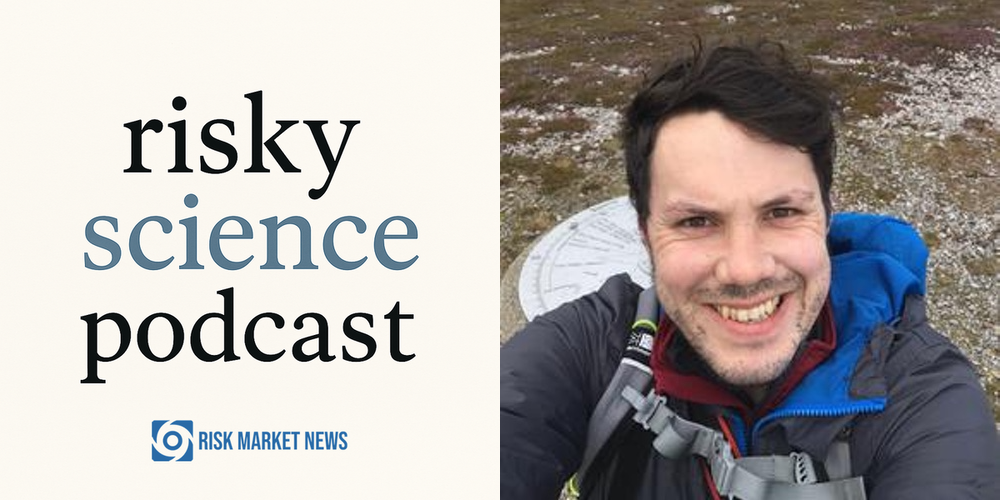
"If we can understand how data is reaching us — or why it's not reaching us — we can account for that within the modeling framework," says Dr. Ben Swallow, lecturer in statistics at the University of St. Andrews and a key figure in Scotland's COVID-19 Research Consortium in this week's Risky Science Podcast. "We may end up with more uncertainty in our estimates than we'd like, but we can still use the available data to understand what's going on."
Swallow's work sits at the intersection of Bayesian statistical inference, uncertainty quantification, and epidemic modeling — a set of tools he argues has direct parallels to the frameworks used in catastrophe modeling and quantitative finance. In a conversation, he walks through why pandemic bonds largely failed to trigger during COVID — "trigger points based on raw death counts are challenging because that data isn't necessarily a perfect representation of reality" — and what a better-designed parametric structure might look like, including a continuous severity scale rather than a binary threshold.
On the modeling gaps that matter most to private markets, Swallow points to two: spatial heterogeneity (the failure of COVID models to account for dramatically different regional outcomes by economic background) and genetic surveillance, where continued investment in rapid pathogen sequencing could enable early local intervention before an outbreak reaches pandemic scale.
Risky Science Podcast — Ebola, Statistics, and What Pandemic Science Can Teach Markets — with Dr. Ben Swallow — available now.
👉 Listen to the full episode
The Risky Science Podcast is published by Risk Market News. Subscribe below or find us wherever you listen.
