


To gain full access to Risk Market News, become a premium subscriber.
THIS WEEK'S RMN
MARKETS · Insurers Could Face $30B Private Credit Capital Call
TThe same mechanics that strained university endowments during the 2008 financial crisis could put insurers on the hook for $30 billion in private credit obligations. — Read →
MARKETS · Basis Risk, Trigger Design Top Concerns as Congress Eyes Parametric FEMA Reform
A congressional report gives a mixed verdict on proposals to shift FEMA disaster aid to a parametric model. — Read →
MODELS · US Insurers Have a Growing "The Model Made Me Do It" Problem
Third-party catastrophe models are making most homeowners insurance underwriting and pricing decisions and regulators are starting to question who's accountable for that. — Read →
MODELS · Catastrophe Models Are Holding the Line on Secondary Peril Uncertainty, Swiss Re Says
When the models lag, the pricing lags — and Swiss Re's new sigma report makes the case that secondary perils are where that gap is widest and the stakes are highest.— Read →
China's Growing Risk Data Moat vs. US Brain Drain
Dr. Hui Su spent 25 years at NASA's Jet Propulsion Laboratory in Pasadena before leaving three years ago to join the Hong Kong University of Science and Technology. While Dr. Su said that she left the US to be closer to family, she says scientists today are leaving the US for China and other countries as a result of changes and cutbacks in US federally-backed climate research.
"Some of my previous colleagues in US and to lost their job and are looking for opportunities in China or in Hong Kong," she says in the member edition of the Risky Science Podcast. "I think this actually is very unfortunate, but for Asia and also in Hong Kong, I think this is a moment of opportunity."
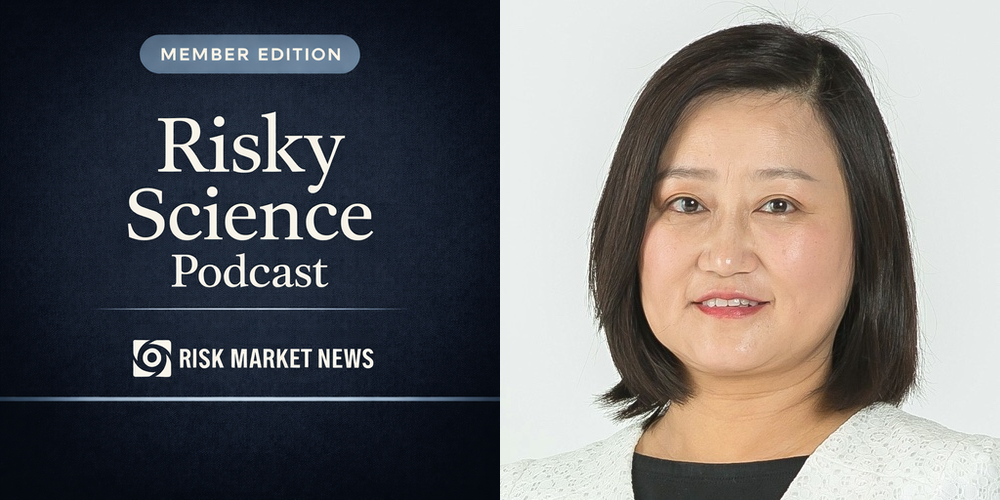
That's because the US exiting the stage for climate research comes just as real advancements are being made by leveraging artificial intelligence coupled with new data sources, Dr. Su explains.
Her research sits at the cutting edge of the combination of satellite data, AI, and extreme weather forecasting. Dr. Su's team built a deep diffusion model that predicts thunderstorm occurrence four hours ahead, nearly double the conventional lead time.
The practical implication for insurers is parametric triggers for convective events that actually correlate with damage, not just historical averages.
Some takeaways from the nearly hour-long podcast discussion:
- The reanalysis gap is closing. China Meteorological Administration's reanalysis data now runs at a ten-kilometer grid versus ECMWF Reanalysis v5 (ERA5) twenty-five kilometers. Dr. Su says the finer granularity incorporates locally observed data — including tropical cyclone wind speed and intensity measurements — that ERA5 simply doesn't have. Her advice to catastrophe modelers: treat them as complementary, not competitive. More data sources means more validation, not more confusion.
- Satellite breaks the data moat problem. Seventy percent of the Earth's surface is ocean with no ground-based radar. A single geostationary satellite covers a third of the Earth's surface with continuous, uniform coverage every 15 minutes. Dr. Su is optimistic that satellite data, combined with AI, can overcome the data access barriers that have slowed weather risk market development across Asia, even where regulatory and sovereignty constraints make ground-based data unavailable.
- The next decade won't be won by the best model. Dr. Su's says AI models like FuXi — developed by Fudan University — are already outperforming the European Centre's IFS model in some regions. In addition , Google's GraphCast runs at a fraction of the computational cost. But all of these models are hungry for training data. "The next decade won't be won by the firm with the best model," Dr. Su says. "It will be won by the firm with the most resilient access to data."
The full interview with Dr. Hui Su is available to Risk Market News members.


